Yamaha Violin Showdown
One source of confusion among our customers is the differences between the Yamaha electric violin models. Here is our definitive take on the pros, cons, and various differences between, the SV-130 (formerly the Concert Select), the SV-150 (Silent Practice Plus), the SV-200 (or Studio Violin), the EV-204/205 (Performer) and the SV-250/255 (Silent Pro) models. Click here to shop all Yamaha violins, where you will be able to filter your selection by price, color and number of strings.
*What about the K (e.g SV-130 versus SV-130K)?
Yamaha has added the letter K to it's model line, much to people's confusion. It stands for "kando," a Japanese word that approximates the community spirit one feels when playing well. It does not denote any extra features, in fact we usually leave it off our descriptions, since it is on all their instruments.
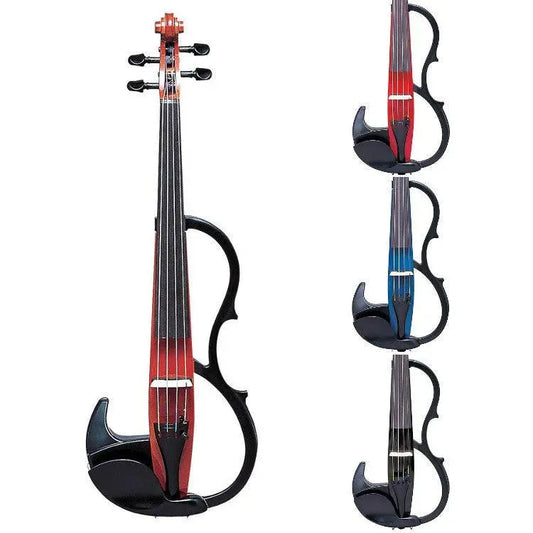
Yamaha SV-130
The first Yamaha electric violin was the SV-100. Called the Silent Violin because it had a headphone jack, it was available only in brown, and had a mini output jack. Suggestions from players prompted Yamaha revise it to the SV-110, and then the SV-120, adding color options and a screwed-on 1/8" to 1/4" adapter plate to allow players to plug into an amplifier with a standard instrument cable along the way. It was also known as Yamaha's Concert Select Violin. The current model is the Yamaha SV-130 Silent Violin, the most consistent entry-level electric violin that we've seen, in terms of build quality. There are a few cheaper instruments that sound almost as good, but they are not put together as well nor are they backed by Yamaha's 5-year warranty; both the sound and the fit and finish of the cheaper entry-level instruments tend to be erratic.
The violin tone of the SV-130 is solid; a warm, acoustic sound very similiar to a "normal" violin, 'though lacking some of the complexity of tone, due to the solid body design of the instrument. The reverb and "hall" settings allow the player to mellow the tone even further, and shape the sound somewhat without the assistance of aftermarket or amplifier-based effects. If the raw sound of the instrument itself doesn't exactly knock your socks off, neither does it knock you upside the head with any unpleasant surprises.
By upgrading the SV-130 to an integrated 1/4" output jack, Yamaha has nearly eliminated the only serious drawback to the SV-120 -- when played through an amplifier, the SV-120 exhibited a low, electronic hiss. While the SV-130 still has a tiny bit of hiss if you turn the volume on the instrument above the 3/4 mark, there's almost none if you keep the instrument's volume lower, and turn up the amp, instead.
Verdict: Over the years Yamaha has eilimated the bugs from its entry-level model -- The SV-130 is a solid performer for beginning through intermediate players. However, if improved tone quality and being able to choose your chin rest or use your own shoulder pad is important to you, consider moving up to the SV-200.
Yamaha SV-150
The SV-150 Silent Practice Plus is among the lightest electric violins on the market. With this instrument, they've clearly sought to create the perfect "silent" practice violin, giving the player a comfortable, well-made instrument that's as light as an acoustic violin, while packing the separate control module with features that will appeal strongly to both younger players new to violin and adult amateurs taking up or returning to the instrument.
The control module is the heart and soul of the SV-150. Serving as a digital tuner and metronome, it's also loaded with digital effects, so that players can experience some of the cool factor of the electric violin world without having to invest in a separate effects processor and amplifier. All the classic sounds are here, from relatively mild reverb, chorus, and delay, to heavy overdrive and distortion, wah -- a little of everything you've ever heard a guitar do.
The other cool thing the control module will do is play back music recorded on an SD memory card. This allows you to download tunes you're working on and play them back through the headphones while you're practicing. Best of all, if you're trying to work through a difficult passage, you can slow down and speed up the song -- as much as twice as fast or half as slow as the original recording speed -- without altering the pitch. If you're trying to figure out a part by ear, this feature alone is almost enough to justify choosing the SV-150.
One drawback of the SV-150 is that Yamaha has kept too tight a focus on their intended purpose for the instrument. It may well be the perfect instrument for silent practice, but not offering an output cable and designing the control module so that the only available output is via a 1/8" line out means that players who want to perform with this instrument will have to purchase a separate adapter cable -- and the line out on the control module is not of a high enough quality to provide a clean connection for going out to an amp or PA.
Verdict: for "silent" practice, it doesn't get any better than this. Lightweight, comfortable, takes your own shoulder pad ('though the chin rest is still molded plastic, and part of the body), and plenty of cool factor from the built-in effects and SD card player. But if you're looking to perform with it, you're likely to have some issues with cable noise when you move around. Yamaha's clearly not designed the instrument for performance -- or taken into account the fact that their customers will most likely want to perform with it, whether they intend it for that purpose or not.
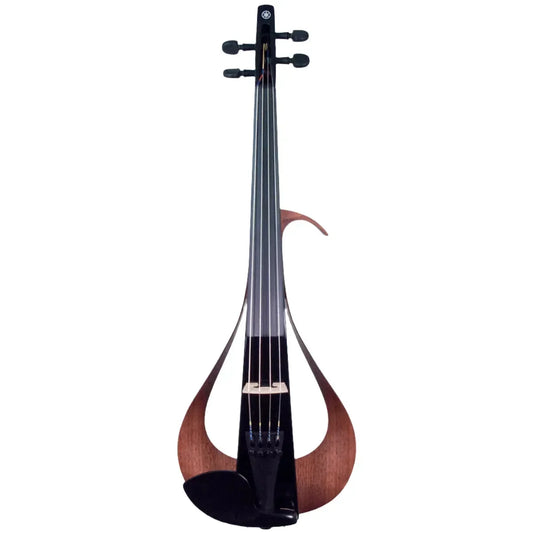
Yamaha SV-200
If a natural violin feel and good tone at amplified volumes is your main goal, you'd be hard-pressed to beat the SV-200 at this price point. To top it off, the familiar lines of the instrument, and the presence of the traditional physical reference points makes for a seamless transition from your acoustic violin to this electric.
Drawbacks? If the SV-200 has one, it's only that Yamaha isn't currently offering it in a five-string model. Apart from that, this is as close to perfect as an electric violin can be, without spending a fair amount more money.
Verdict: Dollar for dollar, this is one of the best pure values in the electric violin market. If a pure, warm acoustic sound is what you're looking for, look no further. But if you're looking for a five-string, you're looking to be disappointed.
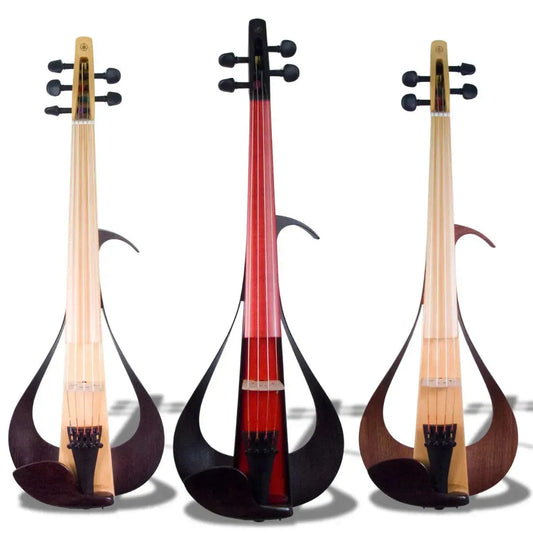
Yamaha EV-204/205
Sometimes called the Performer, the Yamaha Electric Violins, EV-204 and EV-205 offer a more performance oriented design than the SV-series, while retaining silent-practice capabilities. With wilder colors and more active electronics than the "Silent" Violins, it's clear that these instruments are designed to appeal to a different audience.
The tone of the EV series Yamahas has a more electronic sound to it. This is not surprising, really, as the EVs have more active electronics on-board than any of the other Yamahas. The EV-204 and 205 can be played either in "direct" mode, which equally balances the output level that each piezo element in the bridge (the EV series bridges have one pickup per string) sends to the amplifier, or in the "controlled" mode,which allows the player to separately adjust the volume of each individual string.
Overall, this is a fine electric violin. Build quality is exceptionally high, and the sound and playability are consistent. For players who are going to be plugging into an effects loop or otherwise processing their sound, the EV series is a natural choice - a solid, no-compromise solution, especially if you're looking for a five-string electric violin to add some extra low end to your improvising. In addition, the machine tuners make getting this violin in tune and keeping it there a breeze; that alone would be enough to sway some players frustrated from struggling with balky friction pegs.
Verdict: If the purest, most acoustic tone is not your biggest goal, the EV-204 or 205 is an outstanding choice. It plays well, the build quality is excellent, the electronics are solid, and it sounds good, if perhaps a bit electronic. A great violin for rock players and those who love to process their sound or add effects to their playing.
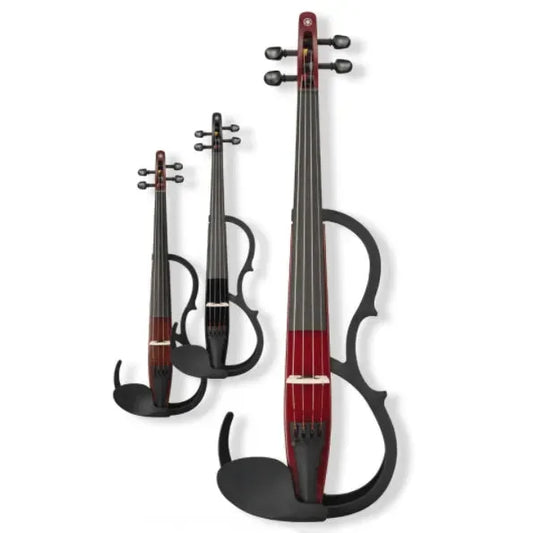
Yamaha SV-250/255
Weighing in at 500 and 530 grams, the SV-250 four string and SV-255 five string are two of the lightest electric violins on the market. Yamaha's slim-down program for these SV models started with removing the electronics from the instrument. A rugged, professional-quality preamp is designed to clip to the performer's belt or be placed on a pedal board.
With their light weight and acoustic tone, the SV-250 and 255 are aimed directly at classical musicians who have resisted heavier, less natural-sounding electrics, as well as gigging professionals who regularly play more acoustic styles. You can use any brand of shoulder rest with these instruments, but the chin rest is fixed. However, it's quite comfortable for most players.
Both instruments employ the SV-series under-bridge piezo pickup, as well as Yamaha's VNP-1 dual-piezo bridge pickup. A pickup blend knob on the back of the instrument allows you to choose the balance between the body and bridge pickups. Used in conjunction with the bass and treble controls on the solidly-built preamp, the player has a huge amount of tone control.
Amplified tone is sweet, clear, and natural -- more like an acoustic violin than many electrics on the market. The highs are not as brilliant or the bass as dark and rich as some other electrics, but tone is even and convincingly acoustic across the full range of the instrument.
The playability of both the SV-250 and 255 is excellent. With the five string, in particular, Yamaha has done an excellent job with string spacing at the nut and bridge curvature, easing the transition to extended range for classically-trained players more used to a traditional four string.


Find Us